
Mathews Projected Versus Actual Release
A projected, estimated, anticipated, or scheduled release date is advance information. It is calculated from the sentences a custodian is administering, jail credit, whether terms run together or one after another, applicable sentence credits, and later legal events. The label matters. A projected date should never be rewritten as an actual release date.
An actual release is a custody event. At MPRSC, the physical release or movement record should show when the regional jail ended or transferred its custody and under what authority. For a VADOC prisoner, final records review and signed release papers are stronger evidence than an earlier projection. A post-departure custody or supervision status can corroborate the event.
A person held before trial has no fixed sentence-end date. Bond, recognizance, dismissal, a court order, and an outside hold can affect whether and when that person leaves. Even after sentencing, the court's disposition date differs from the jail's physical departure time.
Find Mathews Projected Release Dates
Identify the custody system before searching. A Mathews arrest usually points first to Middle Peninsula Regional Security Center. A state sentence may later move into VADOC. Federal and immigration systems are separate. Searching a state locator for someone who only spent time in the regional jail can produce no result even when the identity is correct.
- Confirm whether the person is pretrial, serving a local sentence, or serving a VADOC sentence. Use the Mathews court record and the known custodian.
- For a VADOC prisoner, open the VADOC Inmate and Supervisee Locator. Search by the seven-digit DOC ID when known, or use an accurate name search.
- Match the returned identifier, age, status, and location. Read the public date label exactly as displayed and note the access date.
- For an MPRSC sentence, call 804-758-2338 and ask which records office can explain the locally administered release calculation.
- Check the sentencing order through the proper Mathews court, but do not calculate the date from that order alone.
- Near the forecast date, confirm the actual event with the custodian and use an alert as a timely secondary channel.
The Mathews County released inmate search sets out the full route when the issue is whether the person has already left, rather than when release might occur. A current roster, court result, projected date, and release record answer different questions.
Note: A negative VADOC result does not establish a Mathews County release when the person never entered VADOC custody or supervision.
VADOC Computes Mathews Release Dates
The VADOC Time Computation office explains which authority computes each kind of date. VADOC calculates active earned-sentence-credit sentences longer than 12 months. It also computes discretionary-parole eligibility, mandatory-parole release, and good-time release dates for qualifying parole-eligible good-conduct sentences totaling more than 12 months. MPRSC or the responsible local authority administers qualifying local sentences.
Many inputs can control the calculation. They include the total active term, sentence type, jail credit earned before VADOC receipt, concurrent or consecutive structure, credit classification, disciplinary events, warrants, detainers, amended court orders, and other uncalculated sentences. A simple sentence-minus-days formula cannot safely reproduce the official result.
The official date-computation source shows the framework used for Virginia sentences. Review VADOC's published time-computation information before treating a public date as fixed.
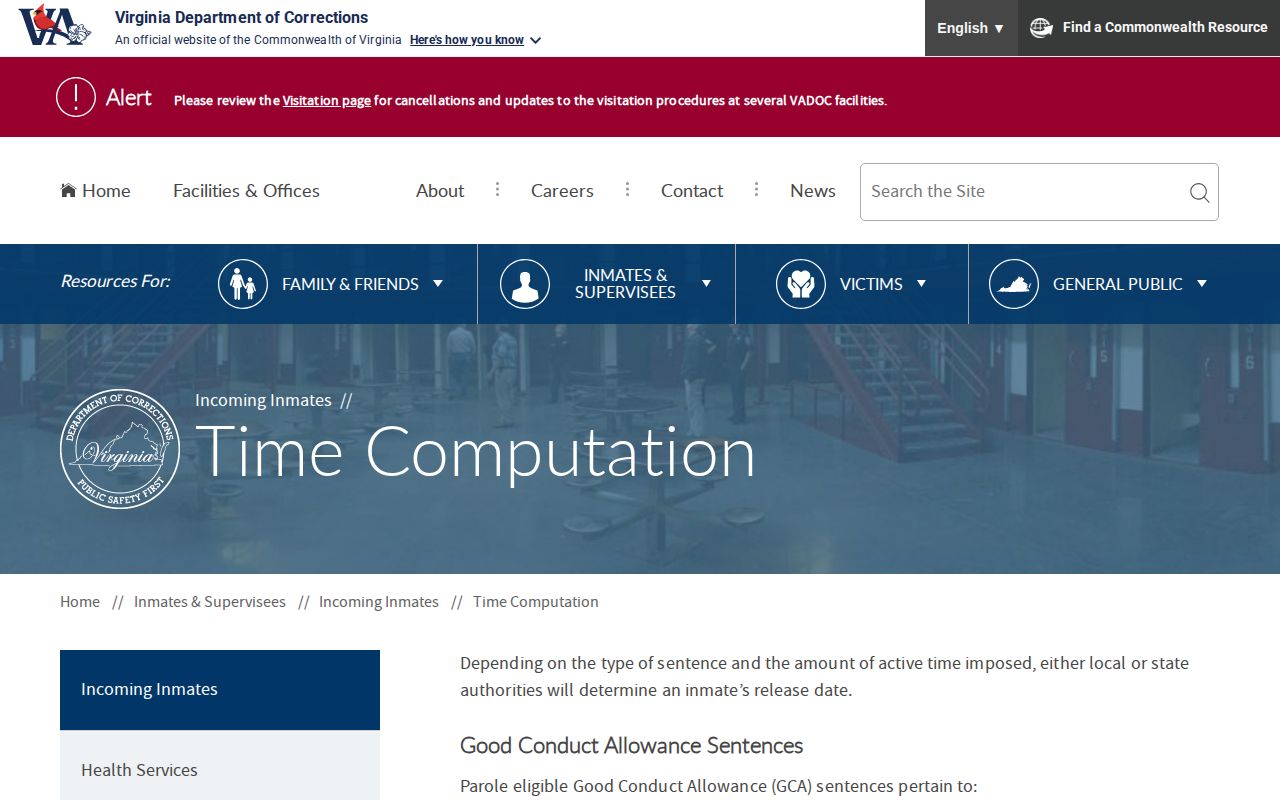
The captured VADOC page reinforces that sentence type and governing law determine which date is calculated and who calculates it.
Mathews Earned Sentence Credits
Virginia uses more than one credit framework. For many felony offenses committed on or after January 1, 1995, Code § 53.1-202.2 defines one earned sentence credit as one day deducted from confinement. Earning depends on statutory eligibility, classification, conduct, and required participation. The version tied to the offense and sentence must be checked because amendments have changed coverage.
Code § 53.1-202.3 sets two broad tracks. Offenses listed in subsection A may earn no more than 4.5 credit days for each 30 days served. Other eligible subsection B sentences use four levels: 15, 7.5, 3.5, or zero credit days per 30 days served, based on classification and compliance. The long statutory offense list should be read directly rather than condensed into a loose offense label.
The common “serve 85 percent” phrase is not a universal Virginia rule. It is also imprecise for the 4.5-day track. Thirty days served plus 4.5 days credited means 30 of 34.5 days, or about 86.96 percent of that credited interval. Other eligible sentences can use different rates, and a mandatory minimum or exclusion can prevent a reduction.
Code § 53.1-202.4 addresses criteria and the Director's forfeiture authority. Discipline, classification changes, program status, and forfeiture or restoration can therefore move the projected release date. Earned credits also cannot reduce time required before parole eligibility where the statute bars that effect.
Mathews Local Jail Release Credits
Local jail credit is not the same as the modern VADOC earned-sentence-credit track. Code § 53.1-116 requires the jailer to maintain a written earned-credit policy. Under the 2026 text, a person serving 12 months or less for a misdemeanor or combination of misdemeanors, without a mandatory minimum, earns one good-conduct day for each day served without violating written rules. Qualifying pretrial jail days can be included.
The same statute contains a separate 15-days-per-30 provision for parole-eligible prisoners and permits up to five added days per 30 for specified assignments or programs where available. Felony limits cross-reference the statewide earned-credit article. These paths must not be mixed. The applicable law depends on the offense, sentence, and confinement.
- Active sentence
- The part of a court sentence that must be served rather than suspended.
- Jail credit
- Time credited for qualifying confinement before the current custodian received or computed the sentence.
- Concurrent
- Terms that run at the same time, subject to the sentencing orders.
- Consecutive
- Terms that run one after another.
- Mandatory minimum
- A required term that generally cannot be cut below the statutory floor.
Older qualifying offense dates may fall under good-conduct allowance statutes rather than modern earned sentence credits. VADOC describes class-based legacy rates from zero to 30 days per 30 served. Do not blend the older GCA table with the modern ESC levels.
Why Mathews Release Dates Change
A projected date changes when an input changes or when final review finds a barrier to discharge. VADOC records staff check VACORIS and the file for unsatisfied warrants or detainers, continued-custody orders, discipline, classification issues, and sentences that have not yet been calculated. MPRSC must likewise verify identity, release authority, and outside holds before ending jail custody.
| Factor | Possible effect on the date |
|---|---|
| Credit earned or restored | May move a qualifying projected date earlier under the applicable credit rule. |
| Credit loss or classification change | May reduce the credit rate or move the forecast later. |
| New or amended court order | Can alter the active term, sentence structure, or credit input. |
| Consecutive sentence | Can add time after another term rather than run at the same time. |
| Warrant or detainer | Can prevent community release or cause transfer to another authority. |
| Parole decision | A grant authorizes the next process but does not itself set the physical departure as complete. |
| Uncalculated sentence | Can require records staff to revise or pause the forecast before discharge. |
Virginia's pre-release check is deliberate. Under 6VAC15-40-1090, jail staff verify identity, lawful release authority, and other-jurisdiction holds. A planned bond or sentence-end date can therefore fail to become community release if another lawful custodian is waiting.
Parole adds another timing layer. Virginia generally ended discretionary parole for felony offenses committed on or after January 1, 1995, subject to statutory exceptions. For a person who remains eligible, a Parole Board grant authorizes the next release process but does not prove that the person has left a VADOC institution. VADOC must still set and execute the date, complete its warrant and sentence checks, prepare the release documents, and identify any supervision that begins after departure. A denial also does not erase another lawful sentence-completion path.
Mathews Weekend Sentence Release Quirk
MPRSC has a local nonconsecutive service program that changes how roster absence should be read. The MPRSC Weekend Inmate Information describes court-permitted sentences with 45 active days or less. Qualifying people report at 6:00 p.m. on successive Fridays and serve the term in weekend blocks.
During a weekday, a weekend-service participant may be outside the regional jail without having completed the sentence. The current MPRSC grid is not a sentence ledger, so a temporary disappearance cannot establish final release. The court order and MPRSC's records control how many service blocks remain.
Lateness or program violations may convert the remaining balance to continuous service. Failure to appear can lead to a capias, which is a court order directing that the person be taken into custody. This Mathews County release-date quirk is why a current-list check must be paired with the actual sentence and movement record.
Note: Weekday absence during court-authorized weekend service is not proof that the active sentence has ended.
Confirm Mathews Actual Release Dates
As the forecast approaches, return to the correct custodian. VADOC's Facility Release information says a person who satisfies a VADOC facility sentence leaves through discharge or parole and receives release documents. Applicable papers may include an Order of Release, Conditions of Probation, or Conditions of Parole, signed and dated by the person and a witness.
VADOC states that facility discharge or parole release occurs by 11:59 p.m. on the release date, weather permitting. That rule applies to VADOC institutions. It does not establish ordinary MPRSC release hours and should not be used to predict a regional-jail departure.
The official release source shows which papers and final checks matter. Review VADOC's facility-release process when the person is leaving a state institution.
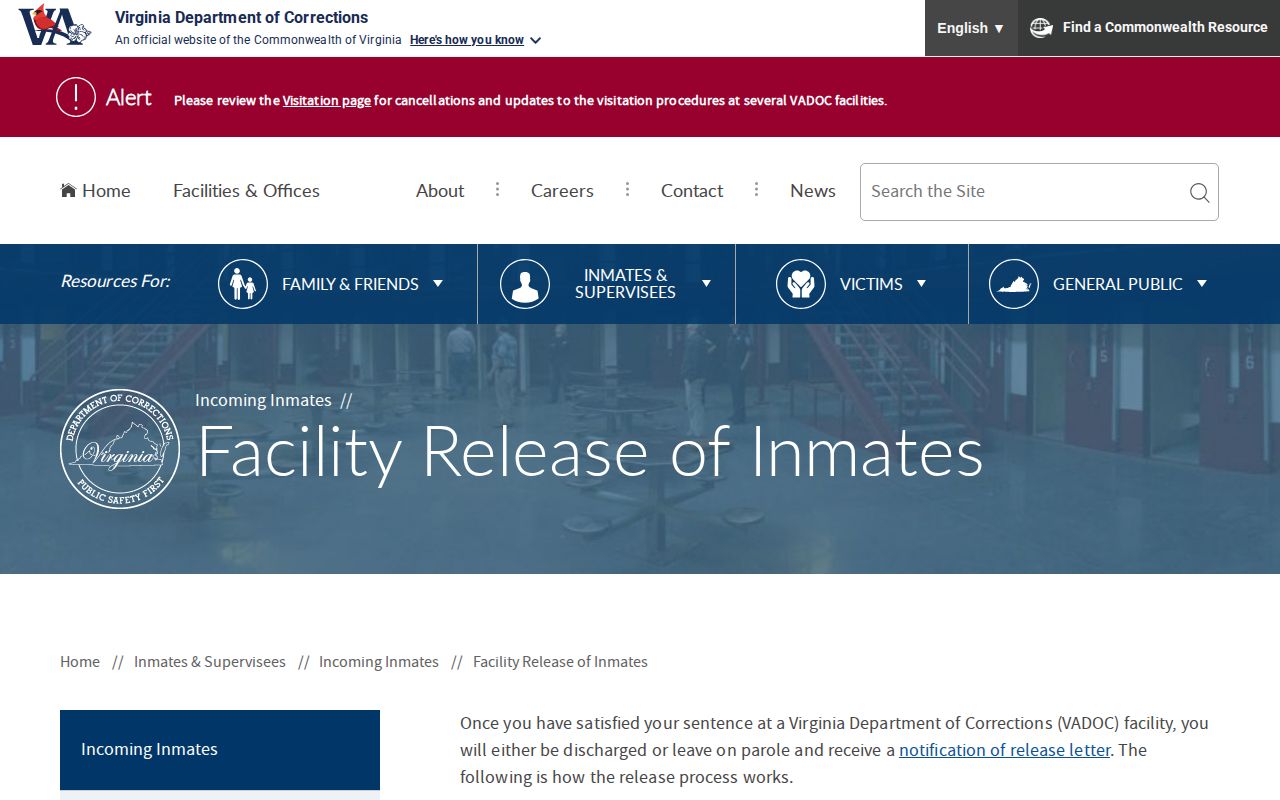
The VADOC release page distinguishes signed discharge or parole documents from a public projection viewed earlier in the sentence.
For MPRSC, ask for the jail's release or movement date and destination. For VADOC, confirm the status, signed documents, and any resulting supervision. A pending custody alert can add timely notice through the Mathews County VINELink inmate search, but the source custodian remains the authority for the event.